Pressure and Help in One Transaction
The 2026 Cuba Poll from Florida International University (FIU) shows Cuban Americans want maximum pressure on Havana and help for Cuba's private sector. Remittances alone run $1.1–2 billion a year, over 95% of them informal. QvaPay is the regulated rail built to do both.
Tim Parsa · Co-Founder & CCO, QvaPay · 3 November 2026 · 3 min read Subscribe
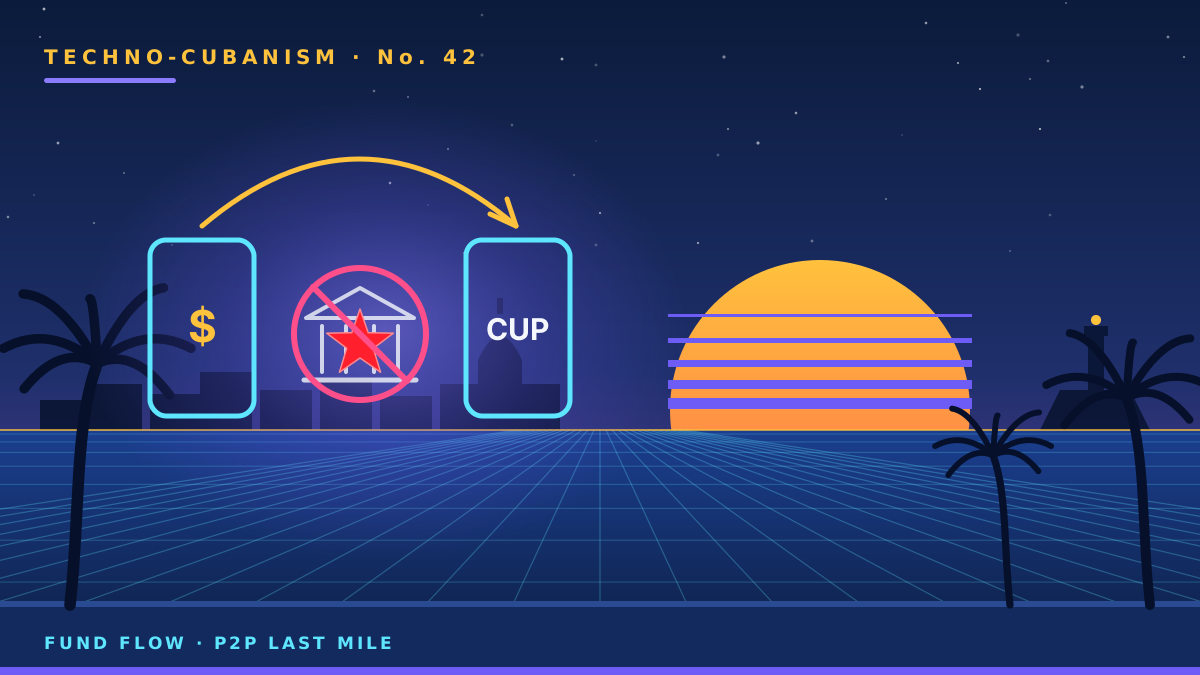
Last week Florida International University (FIU) published its 2026 Cuba Poll, the longest-running survey of Cuban American opinion. Seventy-seven percent of Cuban Americans in Miami want maximum pressure on the Cuban government. Seventy-four percent want U.S. help for Cuba's private sector. Same people, same interview. Investors should read that as a market signal: this community wants to move money to Cubans in a way that gives the regime nothing.
The opportunity
| The signal | The number |
|---|---|
| Remittances to Cuba | $1.1–2B a year (2024; estimates vary) |
| Share moving informally, outside any regulated channel | Over 95% |
| Cuban Americans who sent money last year | 45%, and 70% of those who arrived after 2020 |
| Favor U.S. help for Cuba's private sector | 74%, including 64% of Republicans |
| Reject a deal that keeps the current government in power | 80% |
The demand is large and almost none of it has a regulated home. Western Union paid out through Fincimex, the military's money company, until sanctions shut it in 2020, then through Orbit until it suspended transfers in February 2025. Since 30 September 2026 U.S. law bars even indirect dealings with the companies on the State Department's Cuba Restricted List. A rail that runs through the state has no future in this market.
Why QvaPay is the solution
QvaPay keeps the dollar away from the state. Ana in Miami sends $200 by card, bank or crypto. It reaches her mother's QvaPay account as QUSD, a dollar balance on U.S. books, and never enters a Cuban bank. Her mother can hold it, pay a private shop, or change it with a screened Cuban peer at a rate the two of them agree. QvaPay locks the QUSD in escrow, the peer pays the pesos, and QvaPay releases the QUSD when she confirms. QvaPay never holds pesos or cash. The peer is the ramp.
| Step | The old route | QvaPay |
|---|---|---|
| Where the dollar lands | A state-linked payout company or a Cuban bank | A QUSD balance on U.S. books |
| Who turns it into pesos | The state, at its rate | A screened Cuban peer, at a rate the two agree |
| Where it is spent | State hard-currency stores | Private shops, small and medium private firms (MIPYMES), top-ups |
| Who can switch it off | The state, at one office | No single office: the market runs on its peers |
No legacy rail is left to compete: remittances move informally or on QvaPay. QvaPay's first peer-to-peer (P2P) last mile gives the private sector four things on every transfer:
- Defiance of the regime's rigged exchange rate. Cubans set the rate with each other, not the state.
- More local money for the independent private sector. This week the market paid about 928 pesos per dollar, against 793 at the central bank's floating rate.
- No recipient list for the regime. No state payout office records who received money from abroad. At most, a bank sees a peso payment between two Cubans.
- No dollars for the regime's banks and payment processors. The dollar stays on U.S. books. The peso side is a payment between two Cubans, so the banks never touch the dollar.
Every QvaPay dollar supports the private sector and starves the regime: the state does not hold it, does not set its rate, and does not own the shops where it is spent. Three things make that hard to copy:
- Compliance is built in. QvaPay is registered with the Treasury's Financial Crimes Enforcement Network (FinCEN) as a money services business. Remittances from the U.S. run under § 515.570, and QvaPay's reading of § 515.421 and Frequently Asked Question (FAQ) 756 from the Treasury's Office of Foreign Assets Control (OFAC) treats its services as incident to them. Sentinel screens every party, and Bouncer watches every account and trade.
- The processors are connected. QvaPay connects bank, card, wallet and crypto rails to Cuba's private sector, and takes on the compliance work that comes with them. As far as we know, no other U.S.-registered rail keeps the dollar out of every state bank, state processor and state exchange.
- It is already running. More than 150K registered accounts.
The one in four who say no
About a quarter of the community opposes helping the private sector, because for sixty years help passed through the state. About the old channels, they were right. On QvaPay the dollar never reaches the state, and every party is screened before money moves. Secretary Rubio, the architect of maximum pressure, sends Washington's own aid through the Church on the same logic: around the state, never through it.
Learn more
- QvaPay's numbers and how the rail works.
- Compliance and defiance: defiance of a failed monetary regime, never of U.S. law.
- The full poll card, and FIU's Institute for Cuban Studies.
Sources
- Guillermo J. Grenier and Qing Lai, 2026 FIU Cuba Poll: How Cuban Americans in Miami View U.S. Policies Toward Cuba, FIU Steven J. Green School of International and Public Affairs, October 2026 ↗
- FIU Institute for Cuban Studies, FIU Cuba Poll, 1991–2026 ↗
- Electronic Code of Federal Regulations (eCFR), 31 CFR § 515.209, transactions with entities on the Cuba Restricted List ↗
- Havana Times, Western Union closes its Cuba service after U.S. sanctions on Fincimex, November 2020 ↗
- Havana Times, Western Union suspends money transfers to Cuba, February 2025 ↗
- U.S. Department of State, first humanitarian flight to Cuba under Secretary Rubio's $100 million commitment, July 2026 ↗
- CiberCuba, Cuba and remittances (cites Cuba Siglo 21: more than 95% informal), April 2026 ↗
If this was useful, pass it to someone building in Cuba.