Compliance and Defiance: The Fintech Parsagram
QvaPay sits where four circles meet: compliance with U.S. law, defiance of a failed monetary regime, fiat dollars, and crypto rails.
Tim Parsa · Co-Founder & CCO, QvaPay · 18 August 2026 · 4 min read Subscribe
People ask how a U.S.-registered company can also be the most subversive financial tool in Cuba. I drew the answer as four circles and called it the Parsagram.
What a Parsagram is. A Parsagram overlaps two sets of opposing domains: here, fiat against crypto and compliance against defiance. Most people never consider where opposites meet. Compliance with defiance, or fiat with crypto, is already a place few look. Overlap two opposing pairs and the rarity compounds: the diagram reveals what almost no one sees. Here, the center is QvaPay.
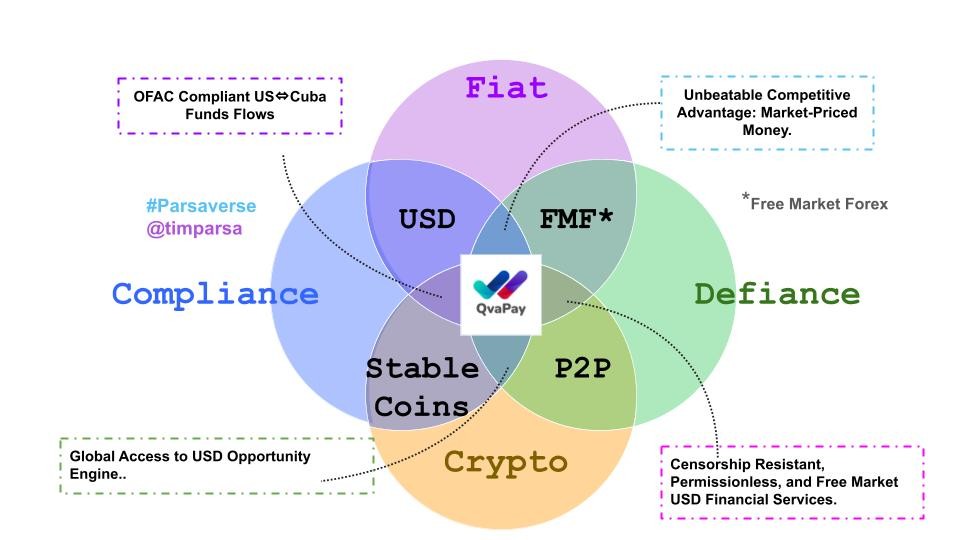
Four circles
- Compliance. U.S. law: a FinCEN-registered money services business, OFAC screening on every party, a written program, records a U.S. bank and examiner can read.
- Fiat. The U.S. dollar, the currency Cubans already price their lives in.
- Defiance. Of the regime’s monopoly on money: its decreed rate, its state banks, its processors. Not of U.S. law.
- Crypto. Rails that move value in seconds, anywhere, at the cost of a text message.
Four overlaps
- Compliance + fiat = USD. sanctions-screened U.S.–Cuba fund flows: remittances, payments, exports, each under its own rule.
- Fiat + defiance = free-market forex. Market-priced money. A peso priced by Cubans, not by decree, is an advantage no state bank can match.
- Defiance + crypto = P2P. Peer-to-peer dollar services the regime can’t switch off, because they run on people, not one office it can raid.
- Crypto + compliance = stablecoins. QUSD, backed one to one by USDC: global access to the dollar opportunity engine, with every address screened.
Take away any circle and the model breaks. Without compliance, no U.S. bank stands behind us. Without defiance, we’re one more channel feeding the state’s exchange rate. Without fiat, there’s no dollar. Without crypto, the dollar arrives in days, not seconds.
The treatment of the P2P exchange itself is the subject of QvaPay’s interpretive-guidance request pending with OFAC. The exchange runs under full controls and no authorization is asserted.
In 2020 I wrote that money you earn legally but can’t move or convert freely is a violation of your rights. Uphold and Airtm were my first answers. QvaPay is the sharpest one: built to comply with U.S. law, and a standing act of defiance against a regime that wants to own the price of money.
Compliance is how we earn the right to operate. Defiance is why it matters.
Remittances are compliance, the peer market is defiance, crypto is global reach: all inside U.S. law.
| Flow | How we grow it | U.S. tech meets Cuban talent |
|---|---|---|
| Remittances Permitted · 31 CFR §515.570 (U.S. senders) | Marketing by use case to the diaspora in Miami and beyond; every sender and recipient screened. | Diaspora dollars become working capital for families and the private businesses they start. |
| P2P forex Pending with OFAC · no authorization asserted | SkyMind matches orders and more screened traders join. | Every trader is a small business: Cubans earn a spread connecting dollars and pesos. |
| Crypto funding and withdrawals Own funds, screened addresses · withdrawals by persons in Cuba: pending with OFAC | USDC from and to screened wallets, settled by Crypto Teller. | Cubans hold dollars on a phone, the way the rest of the internet does. |
The potential. Remittances into Cuba run an estimated $1.1–2B a year (2024; estimates vary). At the Dominican Republic’s rate per person, Cuba would receive about $9.8B, five to nine times today. That is the market QvaPay is built to serve.
| Market | Cuba today | Cuba at the Dominican Republic’s rate per person |
|---|---|---|
| Remittances received | $1.1–2B 2024 est., estimates vary | $9.8B DR total $11.9B (2025) |
A scenario, not a forecast. The Dominican Republic received $11.9B in remittances in 2025 across 11.4 million people, about $1,040 a person; at that rate Cuba’s 9.43 million people would receive about $9.8B a year, five to nine times today. Method and sources.
Not one U.S. bank onboarded a Cuban entrepreneur under the 2024 rule, because OFAC never set a due-diligence standard. Legal authorization has little value if intermediaries won’t act on it. On cubanew.com ↗
Sources
If this was useful, pass it to someone building in Cuba.