Cuba Opened Oil & Gas Exploration to the Private Sector. What Can U.S. Sellers Supply?
A new law lets MIPYMEs and other private firms explore for and produce oil and gas under concessions. We set out what Cuban law lets them do, what U.S. law lets U.S. sellers supply them, and where the line falls.
Tim Parsa · Co-Founder & CCO, QvaPay · 20 October 2026 · 5 min read Subscribe
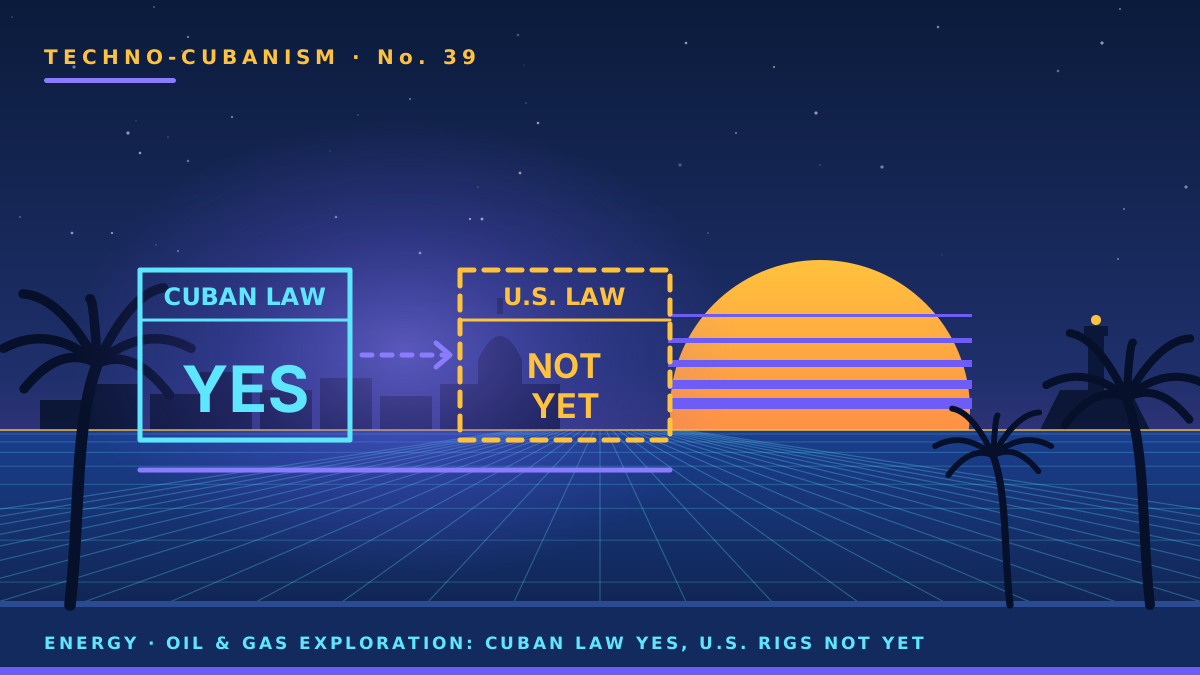
Why now
On 19 October Cuba’s new oil and gas law took effect. Decree-Law 135/2026 and Decree 184/2026 let MIPYMEs, larger private firms and non-agricultural cooperatives take part in oil and gas exploration and production, through concessions and production-sharing contracts [1][2]. Contractors recover their costs from up to 65% of gross production on land and in shallow water, and up to 75% in deep water. The rest is split with the state [1].
A Cuban firm with a concession will want rigs, pumps and well equipment, and U.S. makers build some of the best. Cuban law now lets the firm buy them, but U.S. law decides whether a U.S. company may sell them.
Cuban law, U.S. law, and what is left
| Activity | Cuban law | U.S. law | What the Cuban firm can do |
|---|---|---|---|
| Hold an oil or gas concession | Allowed for MIPYMEs, through tenders and with government approval [1][2] | No U.S. person may invest in it (§ 515.201) [12]. CUPET, the state oil company, is on OFAC’s SDN List [5]. A non-U.S. person operating in Cuba’s energy sector risks designation under E.O. 14404 [9] | Bid under Cuban law, with no U.S. partner or U.S. money, and at its own sanctions risk |
| Buy U.S. drilling and well equipment for the concession | Allowed | Not authorized. License Exception SCP excludes items used to primarily generate revenue for the state [4]. A BIS license meets a general policy of denial [8] | Nothing, from a U.S. seller or through QvaPay |
| Buy U.S. fuel for its own business | Allowed. Private firms already import U.S. fuel [1] | Allowed under SCP § 740.21(b)(1), as BIS confirmed on 4 March 2026, if no Cuban-owned bank receives the money [3][4] | Buy it and pay the U.S. seller from its QvaPay business account [6][7] |
| Buy U.S. solar, batteries, inverters or generators for its own power | Allowed. Solar systems pay no Cuban import duty through 2027 [10] | Allowed under SCP § 740.21(b)(1), for items that are EAR99 or controlled only for anti-terrorism reasons [4] | Buy it on one of the three permitted routes [11] |
What U.S. exporters can still sell these firms
- Sell power equipment. Solar panels, batteries, inverters and generators for a private firm’s own power, when the items are EAR99 or controlled only for anti-terrorism reasons [4].
- Sell fuel for the firm’s own operations. Gasoline and diesel to a Cuban private business for its own economic activity, under SCP [3][4]. The money may not be deposited in a Cuban-owned bank [3], and the fuel may not move through CUPET or its facilities [5].
- Sell other inputs for private business. Tools, parts and equipment for the firm’s own private economic activity, on the same SCP terms [4].
What U.S. exporters cannot do
- Equip a concession. Rigs, well equipment, oilfield pumps and services for oil or gas extraction. SCP does not cover items used to primarily generate revenue for the state, and the state takes its share of the oil [1][4].
- Count on a license. Cuba’s export licensing policy is a general policy of denial. BIS says it generally denies items for state enterprises that extract minerals or other raw materials, and the case-by-case licenses it grants usually bar uses that primarily generate revenue for the state [8].
- Deal with CUPET. That rules out CUPET as partner, buyer, operator, terminal or tank farm. CUPET has been on the SDN List since 11 June 2026 [5].
- Invest. No general license lets a U.S. person take a stake in a Cuban concession [12].
Where QvaPay fits
Fees: QvaPay Payments 2.5% on U.S.-made goods and 5% on foreign-made goods sold from U.S. stock; QvaPort Logistics 5% when QvaPort consolidates. Freight and Cuban port charges are paid in CUP, outside QvaPay [11].
What would change the answer
It would take a specific BIS license with an OFAC authorization for the transaction, or a change in U.S. policy toward Cuban energy. Until then, a private oil concession is a Cuban-law opportunity that U.S. sellers cannot equip, while fuel and power for private business is open now. Learn more: What a Cuban private business can and cannot do with QvaPay · How to sell to Cuba’s private sector from Florida
Not legal advice. Confirm your structure with OFAC and export-control counsel.
Sources
- 14ymedio, “La Habana intenta atraer inversiones privadas en el sector petrolero con una nueva ley,” 12 October 2026 ↗
- cubanew.com Reform Watch, Decree-Law 135/2026 and Decree 184/2026 (Gaceta Oficial No. 85, 12 October 2026) ↗
- Bureau of Industry and Security, License Exception SCP: gas and petroleum products, and Cuban-owned banks, 4 March 2026 ↗
- eCFR, 15 CFR § 740.21, License Exception Support for the Cuban People (SCP) ↗
- OFAC, Recent Actions, 11 June 2026: Unión Cuba-Petróleo (CUPET) added to the SDN List ↗
- eCFR, 31 CFR § 515.533, exportations from the United States to Cuba ↗
- OFAC, FAQ 756: online payment platforms and authorized transactions ↗
- eCFR, 15 CFR § 746.2, Cuba (licensing policy) ↗
- U.S. Department of State, Sanctioning Cuban State-Owned Banco Internacional de Comercio, S.A. (BICSA), 15 October 2026 (E.O. 14404 sector risk) ↗
- CiberCuba, Resolution 180/2026 keeps solar import duties at zero through 2027, 8 August 2026 ↗
- cubanew.com, How to sell to Cuba’s private sector from Florida ↗
- eCFR, 31 CFR § 515.201, transactions involving property in which Cuba or a Cuban national has an interest ↗
- cubanew.com, What a Cuban private business can and cannot do with QvaPay ↗
If this was useful, pass it to someone building in Cuba.