Made in USA, Half the Fee
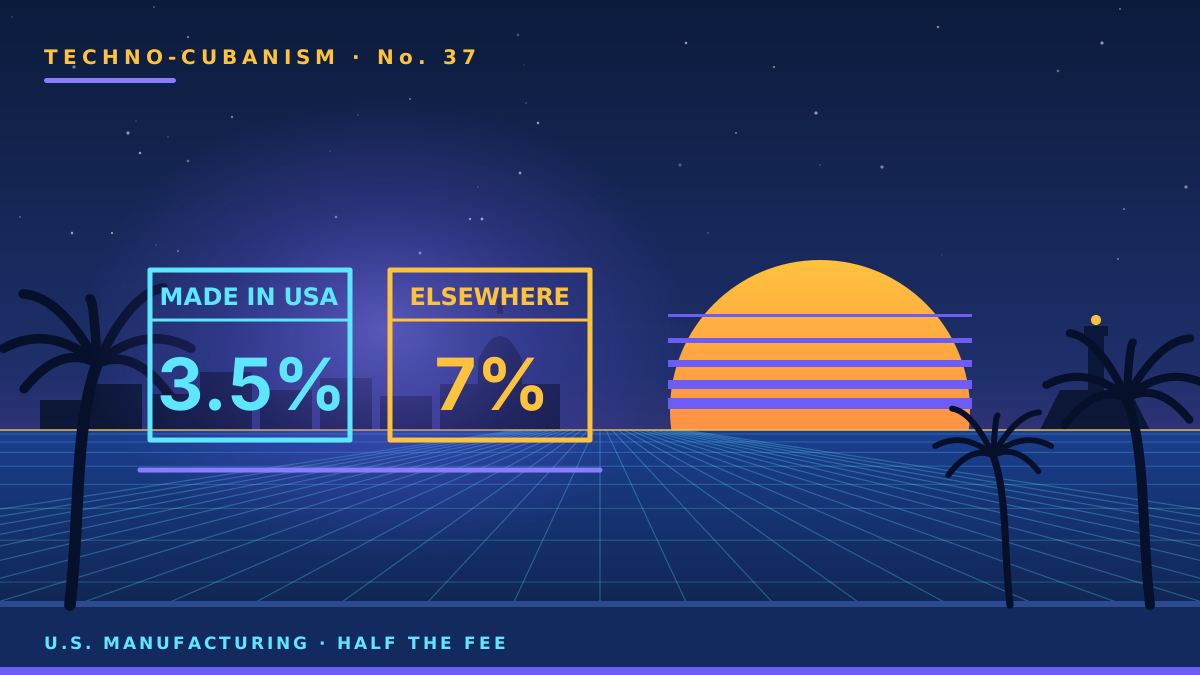
Since 30 September a Cuban private business can only pay a U.S. seller. We want the factory behind that seller to be American too, so from 14 October U.S.-made goods pay QvaPay half the fee.
Tim Parsa · Co-Founder & CCO, QvaPay · 14 October 2026 · 4 min read Subscribe
Why now
On 30 September Treasury closed the offshore dollar routes into Cuba [1]. A Cuban private business can no longer wire a factory in China through Panama; the U.S. correspondent bank rejects it. The route that works now runs through a U.S. seller, paid from QvaPay [2].
That makes the U.S. seller the gate. The question is what sits behind it: a U.S. factory, or a foreign one with a U.S. warehouse.
The tech
U.S. factories are making again exactly what Cuba's private sector lacks. U.S. solar module capacity passed 60 GW in October 2025, up 37% in ten months; inverters reached 28 GW, and battery cells for stationary storage passed 21 GWh [3]. With a new ingot and wafer plant online, SEIA says every step of the solar supply chain now exists in the U.S. [3].
Panels, batteries, inverters, pumps and tools are what a Cuban bakery, farm or workshop needs to run without the state's grid. Learn more: Featured partners · Connecting U.S. Solar to Cuba
The need vs. what's met
The U.S. sold Cuba about $490 million of food and farm goods in 2025, and about $174 million of everything else [4]. Chicken alone was about $299 million [5]. U.S. technology barely shows up.
Old way vs. new way
Old way: pesos, street dollars, a Panama account, a wire to the factory. About 12% in fees for the payment alone, with no logistics, and since 30 September the wire is rejected.
New way: the Cuban business pays a U.S. seller from its QvaPay account. QvaPay releases the money against the invoice and export papers, and QvaPort consolidates and ships from Florida.
| Goods (from 14 October 2026) | QvaPay Payments | QvaPort Logistics | All-in |
|---|---|---|---|
| Designed and made or assembled in the U.S. | 3.5% | 5% | 8.5% |
| Everything else, even from U.S. inventory | 7% | 5% | 12% |
What counts as U.S.-made
Designed in the U.S. and made or assembled in the U.S. Both have to be true. A product designed in California and assembled in Texas pays 3.5%, even with imported parts. A product designed or made abroad pays 7%, even when it ships from a Florida warehouse.
The exporter attests where the product was designed and where it was made or assembled. QvaPay checks that against the invoice and the export filing [6], which it already collects before it releases a payment. Learn more: How to sell to Cuba’s private sector from Florida
Why we price it this way
U.S.-made goods are the clearest case under U.S. law: a U.S. export, sold by a U.S. company, paid in the U.S. [2]. Foreign-made goods sold from a U.S. distributor’s own inventory are a U.S. export too: once goods are in the United States they are subject to the EAR whatever their origin, and they ship under the same §515.533 authorization [2]. The lower rate is a preference for U.S. factories, not a difference in the law.
And it's who we want to build with. U.S. panels still cost more than Chinese ones, and a 3.3.5-point fee gap won't close that alone [7]. It does tell U.S. makers that the new Cuba is a market built for them.
Who makes it
U.S. solar makers we feature include Tandem PV, Swift Solar, Caelux, Erthos and Paired Power. See every featured partner, U.S. companies listed first, then non-U.S. companies, then Florida distributors.
Know a U.S. manufacturer?
We're opening conversations with U.S. makers of solar, storage, pumps, tools and farm equipment. If you know someone at one of them, introduce us.
Sources
- Federal Register, Cuban Assets Control Regulations, 30 September 2026 ↗
- cubanew, How to sell to Cuba’s private sector from Florida (our guide) ↗
- Solar Power World / SEIA, “The entire solar supply chain has now been reshored in the U.S.,” 29 October 2025 ↗
- U.S.-Cuba Trade and Economic Council, Economic Eye on Cuba, May 2026 ↗
- USDA Foreign Agricultural Service, Cuba ↗
- 15 CFR 30.6(a)(11), the export filing’s domestic or foreign indicator ↗
- pv magazine / OPIS and Anza, Chinese and U.S.-assembled module prices, July 2026 ↗
If this was useful, pass it to someone building in Cuba.