What Changed on 30 September 2026, in One Diagram
Treasury closed the offshore dollar routes into Cuba and narrowed the U.S. ones. Here’s exactly what moved.
Tim Parsa · Co-Founder & CCO, QvaPay · 30 September 2026 · 5 min read Subscribe
On 30 September 2026 Treasury rewrote the rules for dollars moving to and from Cuba. The headlines said sanctions got tighter. They did. More precisely, the rule closed the offshore routes and narrowed the U.S. ones.
Four changes
| Rule | Before | After |
|---|---|---|
| The U-turn | U.S. banks could process a dollar transfer that starts and ends outside the U.S. with a Cuban interest. | They may only reject it. A Panama-to-China wire for a Cuban buyer dies at the New York correspondent. |
| Entrepreneur accounts | U.S. banks could hold accounts for Cuban independent entrepreneurs. | Removed. What survives is the account that receives authorized payments and sends them to Cuba, “including through an online payment platform.” |
| Restricted List | Direct transactions with listed Cuban entities prohibited. | Direct and indirect. Acting as the middleman for a listed entity is now a violation. |
| Anti-evasion | The evasion ban covered the core prohibitions. | Extended to the Restricted List: structuring a deal to get around it is itself a violation. |
Two other squeezes were already in place. Executive Order 14404, signed in May, put foreign banks that deal with blocked Cuban state companies at risk of losing their U.S. correspondent accounts. And major carriers had already stopped calling at Cuban ports.
The diagram
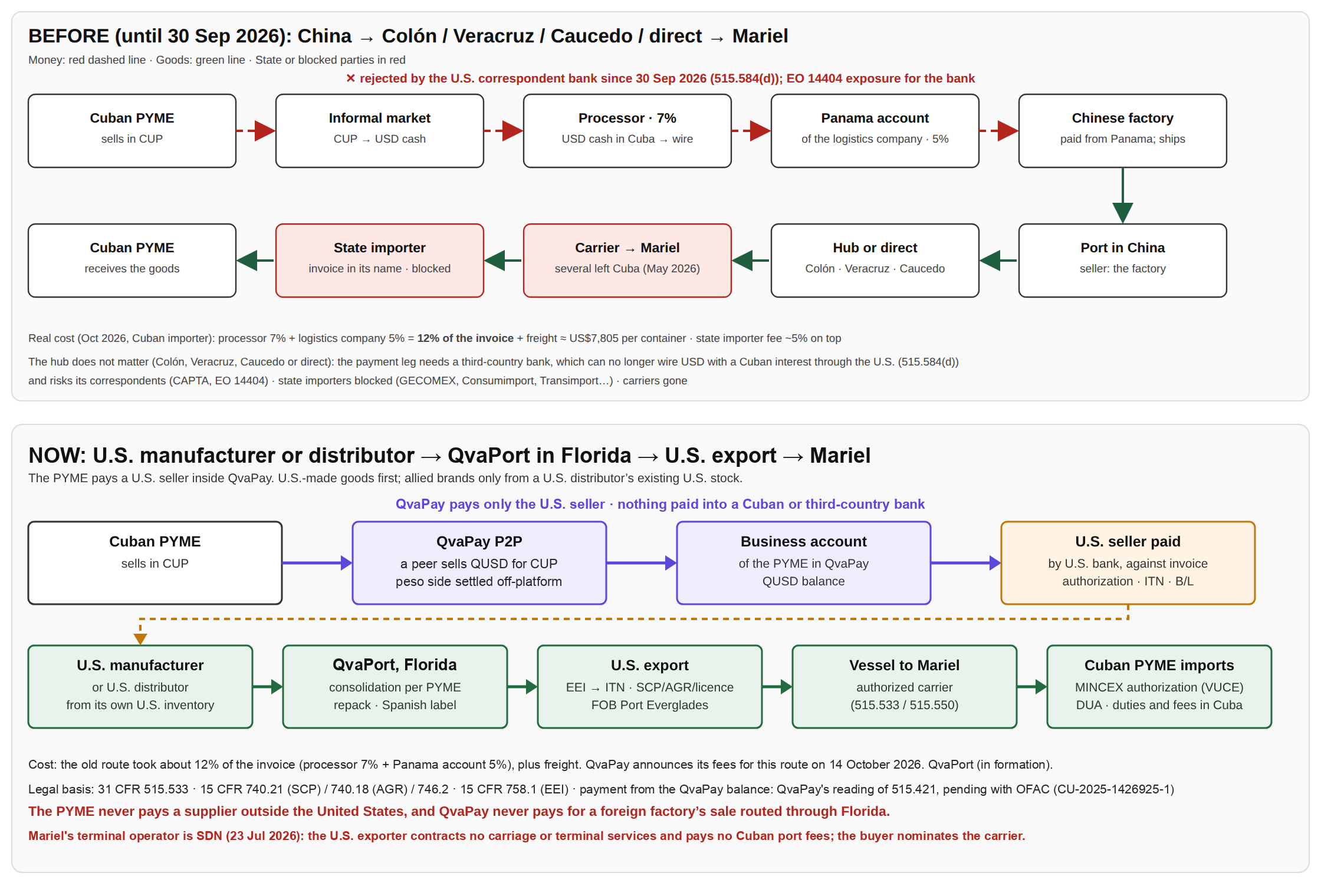
What closed
Money that starts in Cuba and ends in a third country. A Cuban business paying a foreign factory for foreign goods. A wire from a Cuban account to a bank in Panama. The old import route did exactly that: pesos into street dollars, a cash processor taking 7%, a Panama account taking 5%, a wire to the factory. Twelve percent of the invoice, and now rejected.
What stayed open
- Remittances from the United States to family and to private businesses.
- Payments by Americans to Cuban entrepreneurs for their goods and services.
- U.S. exports authorized by Commerce, sold by U.S. manufacturers and distributors.
- U.S. internet services and software sold to Cubans.
- Online payment platforms processing all of the above.
Since that day, a Cuban business on QvaPay pays only U.S. exporters, for goods that leave the United States. No wires to third-country banks. No state company as buyer, payer, payee, or end user.
At Uphold and Airtm, every new sanctions rule meant redrawing the map of what our users could do. On 30 September 2026 we redrew QvaPay’s, flow by flow, and published it in Spanish and English so our customers and the U.S. companies selling to them could read it the same day we did.
The rule closed the offshore routes. We stopped the rest the same day and run only the ones left standing.
The 30 September 2026 rules left remittances and U.S. exports open, closed payments to suppliers outside the U.S., and left entrepreneur payments pending with OFAC.
| Flow | How we grow it | U.S. tech meets Cuban talent |
|---|---|---|
| Remittances Permitted · 31 CFR §515.570 (U.S. senders) | Marketing by use case to the diaspora in Miami and beyond; every sender and recipient screened. | Diaspora dollars become working capital for families and the private businesses they start. |
| Payments to digital entrepreneurs Permitted for U.S. clients · §515.582, §515.340(b) · the freelancer's balance in Cuba: pending with OFAC | When OFAC answers, we market to Cuban freelancers and their U.S. clients. | Cuban coders, designers, and writers sell their skills to the world. |
| U.S. exports through Florida Export allowed (§515.533) · payment from a Cuban balance: QvaPay's reading, pending with OFAC | A logistics hub in Florida, close to the U.S. manufacturers and distributors we pay. | U.S. makers and distributors sell to Cuban workshops, farms, and clinics, U.S.-made goods first. |
| Payments to suppliers outside the U.S. Suspended since 30 September 2026 · not processed | Not offered. It would need an OFAC authorization we have not requested. | Restored, it lets Cuban businesses buy from suppliers outside the U.S. again. |
The potential. Remittances into Cuba run an estimated $1.1–2B a year (2024; estimates vary). At the Dominican Republic’s rate per person, Cuba would receive about $9.8B, five to nine times today. That is the market QvaPay is built to serve.
| Market | Cuba today | Cuba at the Dominican Republic’s rate per person |
|---|---|---|
| Remittances received | $1.1–2B 2024 est., estimates vary | $9.8B DR total $11.9B (2025) |
A scenario, not a forecast. The Dominican Republic received $11.9B in remittances in 2025 across 11.4 million people, about $1,040 a person; at that rate Cuba’s 9.43 million people would receive about $9.8B a year, five to nine times today. Method and sources.
Flights, remittances, and diaspora travel were untouched by the 30 September 2026 rules; the entrepreneur-account removal was mostly signaling, since banks never had KYC guidance for it. On cubanew.com ↗
Sources
- Federal Register, Cuban Assets Control Regulations, 30 September 2026 ↗
- OFAC, Cuba-related alert of 29 September 2026 ↗
- OFAC FAQ 1271: indirect transactions with the Cuba Restricted List ↗
- OFAC FAQ 1272: the U-turn general license ↗
- OFAC FAQ 1273: accounts of independent private sector entrepreneurs ↗
- OFAC FAQ 748: accounts receiving authorized payments ↗
- OFAC FAQ 756: online payment platforms ↗
- eCFR, 31 CFR § 515.584 ↗
- eCFR, 31 CFR § 515.209 ↗
- eCFR, 31 CFR § 515.201 ↗
- U.S. Department of State, Cuba Restricted List ↗
- cubanew.com, the September 2026 Cuba sanctions changes ↗
- Periódico Cubano, Cuba’s private sector imported nearly $1.2 billion in the first half of 2025 ↗
If this was useful, pass it to someone building in Cuba.