P2P Forex: Cuba’s Freedom & Opportunity Accelerant
Every peer trade is a price the state didn’t set, on a dollar the state never touched.
Tim Parsa · Co-Founder & CCO, QvaPay · 23 September 2026 · 5 min read Subscribe
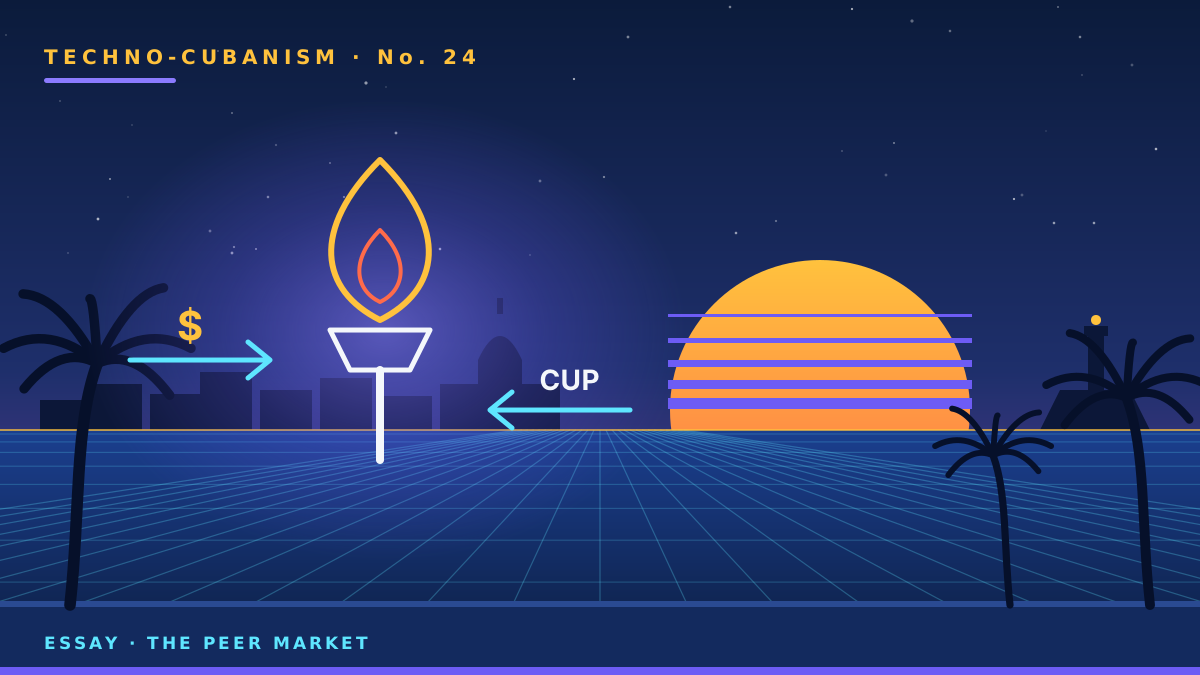
Cuba’s private sector didn’t wait for a bank. More than 11,000 private businesses have been approved since 2021, and private retail now outsells the state. The fuel under that boom is the peer market: Cubans trading dollars and pesos with each other, at prices they set themselves, on a U.S. platform the regime doesn’t control.
How it works
- Dollars arrive from the United States, as a remittance, a payment for work, or a payment for goods, and sit as QUSD in a verified QvaPay account, backed one to one.
- The holder picks a peer on the marketplace and sells QUSD at the rate that peer quoted.
- The peer pays pesos from their own money, directly to the seller. That leg settles between them, outside QvaPay.
- QvaPay releases the QUSD to the peer when the seller confirms. It records only the QUSD side, never holds pesos, and never handles cash.
It runs the other way too. A private business sells its peso revenue to peers for QUSD, then pays a U.S. exporter for solar panels.
Why it accelerates a free market
- A market price, not a decree. The rate is whatever two Cubans agree. Trade after trade, it becomes the price Cubans use.
- The state never touches the dollar. No foreign funds go into a Cuban bank. The dollars stay in a U.S.-held balance until an independent Cuban buys them.
- Every peer works like a business. Each quotes, competes, and earns a spread. The market adds capacity with every new trader.
Legacy rails feed the regime
| Legacy rail | What it gives the state | QvaPay P2P |
|---|---|---|
| State banks and exchange houses | The hard currency, at the state’s rate. | The dollar stays in a U.S.-held balance; the rate is set by peers. |
| Dollar-only state stores | Deposits converted into balances spent in state shops. | Dollars spent with private businesses and U.S. sellers. |
| State payment apps | A view of who pays whom. | Records kept by a U.S. company under U.S. law. |
| Regime-run processors | A cut of every remittance. The military-run processor behind the old remittance channel is on the Restricted List. | No relationship with any Cuban bank or regime processor. |
Built to comply
- Every peer is verified, typed by verified residence, screened against the SDN List and the Cuba Restricted List, and checked against the prohibited-official and Party-member definitions.
- Volume monitored against each peer’s declared activity, with source-of-funds review on large or fast funding.
- No U.S. person, and no one in the United States, may trade on the market.
- Monitoring on every trade, run by Bouncer and reviewed by our compliance officer, with SkyMind coordinating the market as it ships.
The treatment of the P2P exchange itself is the subject of QvaPay’s interpretive-guidance request pending with OFAC. The exchange runs under full controls and no authorization is asserted.
At Airtm, the rate our users set among themselves became the number Venezuelans trusted more than the central bank’s. Cuba’s peer rate plays the same role. Price discovery is the first freedom a market gives back.
U.S. technology runs the market. Cuban human capital trades on it. The regime sets neither the price nor the terms.
The peer market and withdrawals turn dollars into pesos at a market price, without a state bank.
| Flow | How we grow it | U.S. tech meets Cuban talent |
|---|---|---|
| P2P forex Pending with OFAC · no authorization asserted | SkyMind matches orders and more screened traders join. | Every trader is a small business: Cubans earn a spread connecting dollars and pesos. |
| Assisted withdrawals Pending with OFAC · peer pays from own funds | SkyMind routes each withdrawal to a screened peer who pays from their own funds. | Dollars become pesos in hand from a peer's own funds; QvaPay never pays into a Cuban bank. |
The potential. Remittances into Cuba run an estimated $1.1–2B a year (2024; estimates vary). At the Dominican Republic’s rate per person, Cuba would receive about $9.8B, five to nine times today. That is the market QvaPay is built to serve.
| Market | Cuba today | Cuba at the Dominican Republic’s rate per person |
|---|---|---|
| Remittances received | $1.1–2B 2024 est., estimates vary | $9.8B DR total $11.9B (2025) |
A scenario, not a forecast. The Dominican Republic received $11.9B in remittances in 2025 across 11.4 million people, about $1,040 a person; at that rate Cuba’s 9.43 million people would receive about $9.8B a year, five to nine times today. Method and sources.
Cuba’s private and state sectors live in “two parallel universes”: one at 24 pesos to the dollar, the other at the market rate. On cubanew.com ↗
Cuban private firms rank real, autonomous access to foreign exchange among the three things they most need, and 76% are optimistic about their own 2026. On cubanew.com ↗
Sources
- cubanew.com, permitted U.S.–Cuba fund flows and how QvaPay executes them ↗
- QvaPay, AML/BSA program and transparency page ↗
- EFE/Swissinfo, private SMEs approved in Cuba since 2021 exceed 11,000 ↗
- Directorio Cubano, private sector overtakes the state in retail sales ↗
- Bureau of Industry and Security, License Exception SCP FAQ, 4 March 2026 ↗
- eCFR, 15 CFR § 740.21 ↗
- U.S. Department of State, Cuba Restricted List ↗
- OFAC, Sanctions List Search ↗
- eCFR, 31 CFR § 515.337 ↗
- eCFR, 31 CFR § 515.338 ↗
- Havana Times, "Western Union to Shut Down Cuba Operations Nov. 23rd", 2020 ↗
If this was useful, pass it to someone building in Cuba.